Saturday, 9 May 2015

Engine Cylinder Design and Function - Part 2

Displacement
Volume and stroke


Everybody has heard of a 1.8 litre engine but what does that mean? Simply put it is the internal volume of the of the engines cylinders. This applies to both single and multiple cylinder engines.

In engine speak it’s the total volume dedicated to combusting the engines designated fuel, be it diesel, petrol or whatever. 


However, as usual it’s a bit more complicated than that. They’re 2 factors that determine the volume of a cylinder. These measurements are the bore and the stroke.

Let me be perfectly clear about this – only the bore and the stroke change the volume of the cylinder. It has nothing to do with the length of the connecting rod, what valves your using or even the height of the piston.

So lets get maths bit out of the way. To measure a cylinder it, as stated previously a circle with some height to it. To start with you work out the area of a circle and then multiply that value with the length of the cylinder:


Cylinder volume =  π x r x r x h


π = 3.142

r = the radius of the circle

h = the height of the cylinder


If you have the bore size (lets say 62mm for example) then the radius is just half that which in this case would be 31mm.


So taking our example a cylinder with a bore of 62mm and a stroke of 57.6mm would be as follows;


3.142 x 31 x 31 x 57.6  = 173921.0112 mm cubed


That’s a massive number, but this is mm cubed, and they’re tiny to convert this number into cc (cubic centimetres) we just shift the decimal point over 3 places so we get 173.9210112 cc or 174cc 


So you can see how helpful these 2 numbers are, with the bore and stroke values you can work out the engine capacity. The values are always given for 1 cylinder even in multiple cylinder engines. This means if you have a V6 engine then the total volume is the same as above but multiplied by 6.


In our example above that would be 174 x 6 = 1044 cc


Which in the real world would be classed as a 1.1 litre engine.


So all this seems pretty easy, which it is but all of this bore and stroke lark only tells you half the story. These numbers are the volume of the cylinder ONLY. And more to the point not the physical cylinder, just the volume that the piston travels within. To understand we need to look at an example of the physical engine volume.


The real engine
Volume - clearance and swept 


There are 3 different states when considering the internal volume of any piston engine. These are total, swept and clearance volumes. We’ll start off with the smallest which is the clearance volume.

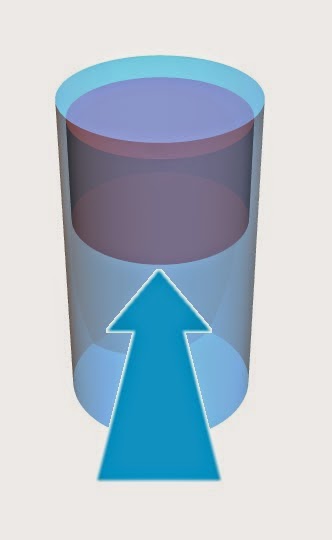
The clearance volume is pictured below and illustrates how this volume is contained. When the piston is at TDC (top dead centre) the remaining space above is the clearance volume. This is also the combustion chamber volume, where all the compressed gases are contained.


The image below is the clearance volume in relation to the entire volume of this cylinder. As you can see this volume only exists when the piston is at TDC


This neatly brings us to the next volume which is the swept volume. This is what your measuring when you take the sum of the bore and the stroke. Now you can see why this value isn’t the actual volume but close enough.

  
The only remaining volume is the total volume. And as you’re already worked out this is the volume of both the clearance and swept volume.




Thursday, 7 May 2015

Engine Cylinder Design and Function - Part 1

Part 1 – Cylinder basics


Volume and configuration

So starting at the very beginning, which we’ll breeze through. A cylinder is as someone once stated – ‘a cylinder is a long circle’

In the respect to an engine, the cylinder is nothing but a void in a cylindrical shape. A piston is fitted inside the cylinder and this piston is travels in a linear motion (up and down in this example). And that’s all there is to it. Simple.


Cylinder arrangement


Some engine have multiple cylinders and we’ll cover why later on, but there several ‘layouts’ that have been quite popular with engineers over the years and here’s a brief description on their names and arrangements.

The single, obviously named due to a single cylinder. Commonly called a ‘thumper’ in motorcycles due to the thumping exhaust note these engine often produce. One cylinder, 1 piston.


The parallel twin, 2 cylinders orientated in parallel with the pistons running in unison. Quite an old design layout rarely seen in modern day engines.


Opposed Parallel twin which shares the same cylinder layout as the twin above but with the 2 pistons running 180 opposed to each other. This design is still used today for reasons we will cover later in the crankshaft section.


The opposing twin, this layout is heavily linked to BMW motorcycles and a 4 cylinder version which was fitted to the VW bettle and the Subaru Impreza.


The V twin arrangement which has seen fame with Harley Davidson and Ducati. The ‘V’ angle has been changed from different models and manufacturers over the years, ranging from 40,60 and 90deg being most common.

 
Opposed piston design – this engine can have 1 or more cylinders with each cylinder containing 2 pistons at either end, with combustion taking place in the centre.

Straight 3 cylinder – named so because – well there’s 3 cylinders in a straight line. This is become more popular in recent years, the reduced number of components with power levels reaching those of 20 year old 4 cylinder engine has increased there usage. Triumph have developed this arrangement with encouraging results in recent years.


The straight 4 – the most common engine configuration due to balance and simplicity. Almost every road can van and tuck on the road today is fitted with this configuration.


The V4 – this has seen a lot of action in the motorcycle racing scene


The U engine – or also know as the square engine. This engine has 2 crankshafts. This configuration was a 1900-10’s design that has was revamped in the 1930’s.


Radial engine – this engine was used primarily in aircraft pre and post WW1, the original variety functioned by rotating the cylinders themselves. The very few engines built today have fixed cylinders.

The straight 6 – obvious name, but this configuration has many benefits which we’ll go over later when covering crankshafts.


The V6 engine – very popular with Porsche and Jaguar for many years. Provides a well balanced arrangement.


The V8 – very popular with the racing scene and hand in hand with the American Muscle Car scene


The W engine – used recently with a lot of press coverage in the Bugatti Veyron. This design has been around for about 100 years. The graphic below isn’t a true reproduction but makes it clearer to understand. The engine runs with a single crankshaft.


There are obiviously other engine formats like the V10 and V12 and V16 and so on but these are the major different configurations that provide different challenges and produce different performance results that we will cover over the coming blogs.